
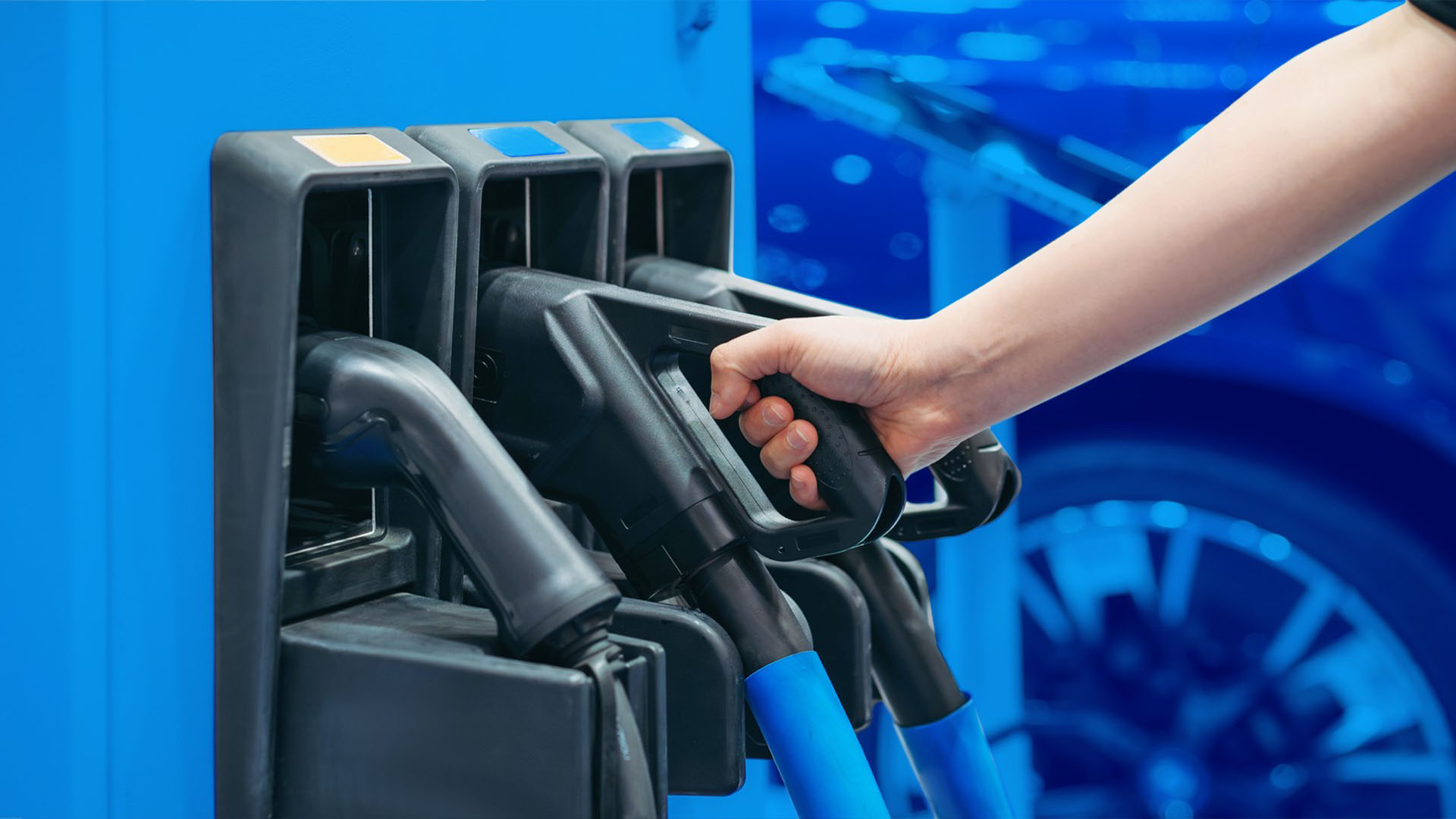
The Plug-Types Decoder — Type 2, CCS and CHAdeMO Without the Jargon
Three connector types you need to know in 2026, and they’re the same across the UK, Guernsey, Gibraltar and the European roaming network. A six-minute read that means you’ll never plug into the wrong charger again.
By Steven Day, Plug-n-Go · Reading time: approx. 6 minutes
In 2026, three EV charging connectors matter across the UK, Guernsey, Gibraltar and the rest of Europe. The good news: they’re the same three everywhere on the Plug-n-Go network and across the European roaming hubs.
Type 2 is the AC connector. Every modern EV has one. It’s what you’ll see at every home wallbox, workplace and destination charger.
CCS is the DC rapid connector. Almost every new EV has one. It looks like a Type 2 with two extra pins below.
CHAdeMO is the older DC rapid connector. Mainly the Nissan Leaf and a handful of older Japanese EVs. Being phased out.
If your car was built in the last five years, you almost certainly have a Type 2 socket and a CCS socket — usually combined into one physical opening on the car. That single socket gets you into more than 99% of public chargers across the UK, Guernsey, Gibraltar and the European mainland. Read on for what to do about the other 1%.
Why connectors look so confusing
Connector standards in the EV world are the legacy of three decades of car-makers, regulators and energy companies in different parts of the world arguing about what an EV plug should look like. The result was four or five competing standards at the peak of the confusion. Things have settled in the last few years; today, in our markets, you really only need to know about three.
Helpfully, the standards are aligned across the territories Plug-n-Go operates in. The UK, Guernsey and Gibraltar all follow the European IEC 62196 family of connector standards, and so do all the major roaming networks across Spain, France, Germany, the Netherlands and beyond. A car bought in any of our three territories will plug into chargers in all of them, and across most of mainland Europe via roaming.
One thing to be aware of: the connector on your car is not the same as the connector on the cable. Sometimes the cable is fixed to the charger; sometimes you bring your own cable. Both ends of the cable matter — the end that goes into the charger, and the end that goes into your car. We’ll come back to this.
Type 2 — the AC connector you’ll use most
Officially: IEC 62196 Type 2. Sometimes called the Mennekes connector after the German company that designed it.
Type 2 is the standard AC charging connector across the UK, Guernsey, Gibraltar and the European mainland. Every modern EV sold in any of our markets has a Type 2 socket on the car. Every public AC charge point on the Plug-n-Go network is Type 2 — either with a fixed Type 2 cable, or a Type 2 socket where you bring your own cable.
Looks like: a circular connector with seven pins inside, slightly flattened at the top.
You’ll use it: every time you charge AC. Home wallbox, workplace, supermarket car park, hotel forecourt, on-street, residential bay-fitted chargers in Gibraltar apartment blocks — same connector across all of them.
Cable: most home wallboxes have a fixed (tethered) Type 2 cable. Public AC chargers are a mix — some tethered, some socketed (bring your own cable, which most EVs are sold with).
Speed: up to 22 kW, depending on the charger and your car’s on-board AC limit (see W1 in this series).
CCS — the DC rapid connector you’ll use on journeys
Officially: Combined Charging System, IEC 62196 Type 2 Combo. Often called CCS2 in Europe (CCS1 is the US version, which you won’t encounter on this side of the Atlantic).
CCS is the DC rapid charging connector for almost every new EV sold across the UK and Europe. It’s “combined” because it physically extends a Type 2 connector with two additional high-power pins below — meaning a CCS socket on the car can accept both a Type 2 AC cable (using just the top part) and a CCS DC cable (using the whole thing).
Looks like: a Type 2 connector with two large round pins beneath it.
You’ll use it: every time you DC rapid charge. Motorway service areas in the UK, Plug-n-Go DC sites in Gibraltar, or roaming partners Iberdrola and Endesa X rapid chargers across the border in Spain — all are CCS.
Cable: always tethered to the charger. CCS cables are heavy and oil-cooled at high power — not the kind of thing you’d carry.
Speed: 50 kW (older units) to 350 kW (current ultra-rapid), with 400 kW units beginning to appear at the highest-spec UK hubs. Smaller-territory networks (Guernsey, Gibraltar) lean on the 50–150 kW range, which is plenty for journey patterns on islands.
Backwards-compatible: a CCS socket on your car will accept a Type 2 AC cable for AC charging. So you only need one socket on the car to do both AC and DC.
CHAdeMO — the connector that’s being phased out
Officially: CHAdeMO 1.0 / 2.0. The name is a Japanese contraction meaning “charge for moving” or “let’s have a tea while charging” depending on which Tokyo engineer you ask.
CHAdeMO is the older DC rapid standard, developed in Japan in 2010. It was the dominant DC connector for years — but Europe (and so the UK, Guernsey and Gibraltar) standardised on CCS for new vehicles, and CHAdeMO is being slowly phased out of the European market. New CHAdeMO charge points are rare; existing ones are gradually being replaced or supplemented.
Looks like: a separate, larger circular connector with four pins. A car with CHAdeMO will have a separate socket from its Type 2 AC socket.
You’ll use it if: you drive a Nissan Leaf (2010–2024), a Mitsubishi i-MiEV, an early Kia Soul EV, or a handful of other older Japanese EVs.
Cable: always tethered.
Speed: typically 50 kW. Some sites support up to 100 kW with newer hardware.
Outlook: most public DC chargers in the UK still support CHAdeMO alongside CCS, but new installations increasingly skip it. Coverage is thinner in Gibraltar and on Spanish inter-city corridors, and varies on Guernsey site-by-site. Plan accordingly if you drive a CHAdeMO-only car: more pre-trip planning, fewer alternatives at busy sites — and check the Plug-n-Go app for supported connectors before you set off.
Tesla — what you need to know
Three things, all practical:
First, Tesla cars sold in Europe (including the UK, Guernsey and Gibraltar) from 2019 onwards use a Type 2 socket for AC and CCS for DC — the standard European setup. They plug into Plug-n-Go chargers and any other CCS rapid the same way every other modern EV does. There’s no special Tesla equipment needed.
Second, older Tesla Model S and Model X (pre-2019) used Tesla’s proprietary European connector and need an adapter for non-Tesla chargers. If you’ve bought a used pre-2019 Tesla, the adapter situation is worth checking before you rely on the public network.
Third, and the bit that’s changed in the last two years: in the UK, Tesla has progressively opened its Supercharger network to non-Tesla cars. Many UK Supercharger sites now have a CCS cable available, accessible via the Tesla app to non-Tesla owners. This is meaningful additional coverage — Superchargers
tend to be reliable and well-located. In Gibraltar and Guernsey, Tesla doesn’t operate Supercharger sites; the Plug-n-Go network and roaming partners are what you’ll use.
How to tell what your car has
Look at the charging socket on the side of the car. The shape tells you the standard.
If you see one socket only, with a seven-pin Type 2 connector and two big pins beneath it: you have CCS, which means you can do both Type 2 AC and CCS DC.
If you see two sockets — a small Type 2 and a separate larger circular one with four pins: you have a CHAdeMO car, with Type 2 for AC and CHAdeMO for DC.
If you see one socket only with the seven-pin Type 2 and no big pins beneath: you can only do AC. Some older EVs (very early Renault Zoe, original Tesla Roadster) and some new entry-level city cars are AC-only.
If in doubt: check the manufacturer’s spec sheet, or look at the icons in the Plug-n-Go app — every charger listing shows the connectors available, and your profile sets your car’s connector once.
What if a charger doesn’t have your connector?
You can’t use it. There are no universal adapters in mainstream use, and homemade adapters aren’t safe at high power. The Plug-n-Go app filters chargers by your connector type — set your car in your profile and the map will only show compatible chargers.
This matters more in two specific contexts. First, if you drive a CHAdeMO-only car (typically an older Nissan Leaf), the supply of compatible rapid sites is shrinking — pre-trip planning is essential, especially on longer UK journeys. Second, if you drive across the border from Gibraltar into Spain, charger coverage is improving fast but is still patchier than the UK on inter-city routes; the connectors are the same European standards, but the operator and roaming-network coverage varies. The Plug-n-Go app and PlugShare together make a reliable pre-trip planning combination — covered in our roaming blogs.
Type 2 + CCS = the modern EV across the UK, Guernsey, Gibraltar and the European mainland. One socket on the car, one connector for AC and one for DC. CHAdeMO is the older alternative, fading out, mostly Nissan Leafs. Tesla in Europe uses CCS for DC; UK Superchargers are gradually opening to non-Tesla cars. Set your car in the Plug-n-Go app once and the connector decisions get made for you.
The Plug-n-Go take
Connector types are settling. CCS won. CHAdeMO will fade out over the next decade. Type 2 AC is universal. The European connector landscape is, finally, simple.
For 99% of EV drivers buying a new car in 2026 in any of our three territories, the connector decision is made for you: you’ll get Type 2 plus CCS, and you’ll be able to use almost every public charger on the Plug-
n-Go network and the European roaming hubs we connect to. The earlier-generation CHAdeMO buyers are increasingly second-hand-only territory; check the connector before you buy used.
The Plug-n-Go network supports Type 2 AC and CCS DC at every public site across the UK, Guernsey and Gibraltar. Selected legacy sites also support CHAdeMO; we publish the supported connectors per charger in the app.
If you’re at a charge point and not sure what you’re looking at, we’re a tap away. Chat to WattBot, our AI service agent on WhatsApp Live Chat, or call our driver-support line on +44 (0)330 232 1111 — answered by humans, every day of the year. Free to call from anywhere on the network.
Our next post: kW explained — what the numbers actually mean for your time at a charge point, and why your car might charge at very different rates on the same charger.
What's the difference between Type 2 and CCS?
Type 2 is an AC-only connector with seven pins. CCS is a Type 2 connector with two additional DC pins below it. A CCS socket on a car can accept a Type 2 AC cable (using just the top pins) or a CCS DC cable (using all the pins). One socket, two charging types.
Are EV connectors the same in the UK, Guernsey and Gibraltar?
Yes. All three follow the European IEC 62196 standards. Type 2 is the AC connector everywhere; CCS is the DC rapid connector everywhere. The same goes for the European roaming network — Spain, France, Germany, the Netherlands and almost every country in our roaming hub use the same standards
Can I charge a Nissan Leaf at a CCS charger?
No. The Nissan Leaf uses CHAdeMO for DC rapid charging, not CCS. You can charge a Leaf on Type 2 for AC (using the second socket on the car), but for DC rapid you need a CHAdeMO charger.
Are Tesla Superchargers usable for non-Tesla EVs?
In the UK, increasingly yes. Tesla has been opening its Supercharger network to non-Tesla cars site-by-site. Access is through the Tesla app, and the cable used is CCS. Tesla doesn’t operate Supercharger sites in Gibraltar or Guernsey; on those islands the Plug-n-Go network and our roaming partners are what you’ll use.
Do I need to bring my own cable?
Sometimes. Most home wallboxes have a fixed cable. Most public AC chargers have a socket — bring the Type 2 cable that came with your car. All public DC rapid chargers (CCS and CHAdeMO) have a fixed cable.
Is there a single connector that works everywhere?
Not quite. Type 2 + CCS gets you to over 99% of public chargers across the UK, Guernsey, Gibraltar and the European roaming network. The remaining gap is CHAdeMO-only sites (mostly older) and Tesla Supercharger sites that haven’t opened to non-Tesla cars yet.
Set your connector once, then forget about it
In the Plug-n-Go app, set your car’s connector in your profile — and the map will only show chargers you can actually use, on our own network and across the 800,000+ roaming partner sites in 60 countries. No guesswork at the bay.