




Is Now the Time to Switch to an EV?
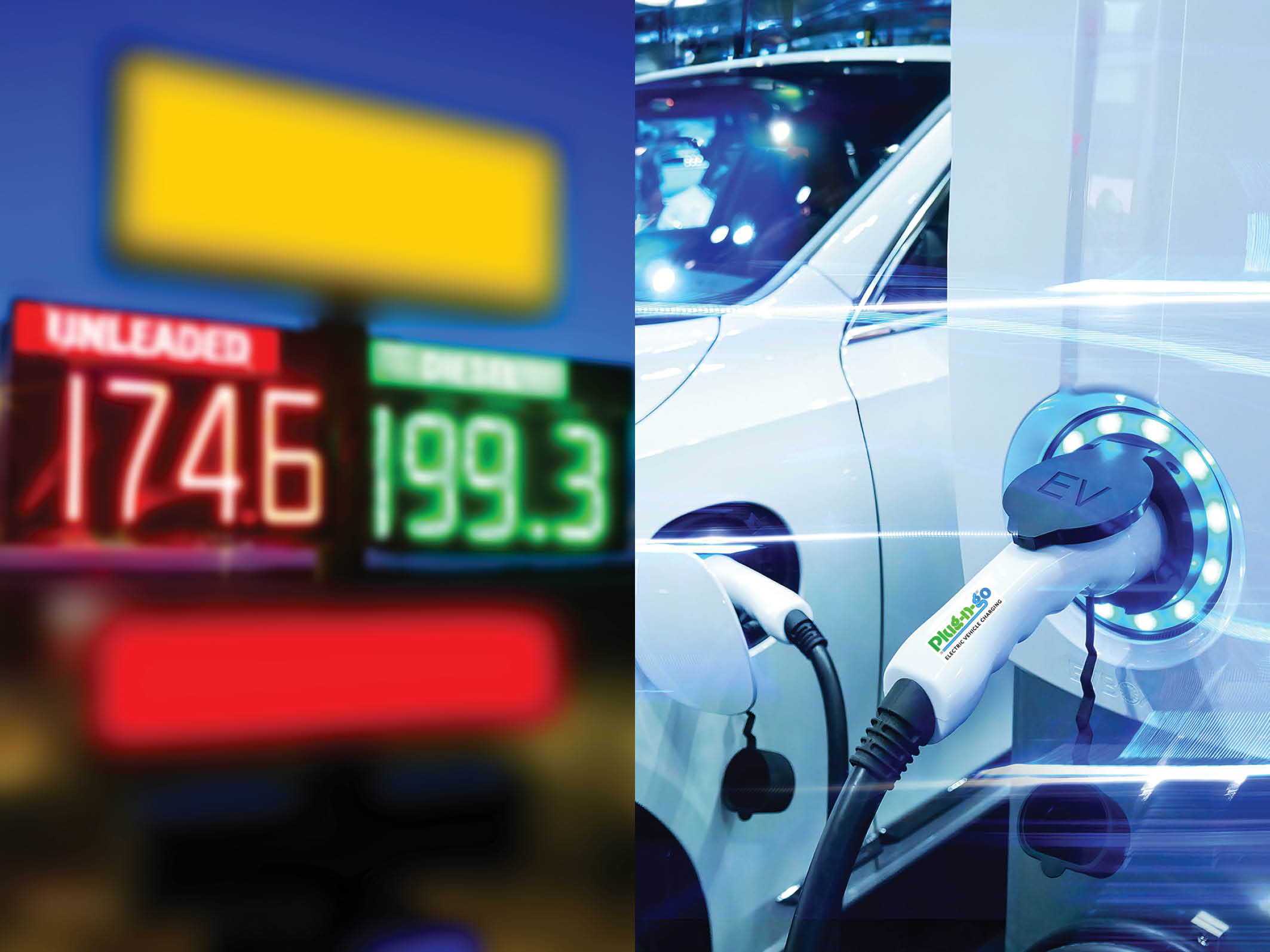
Petrol at 174.6p, diesel at a record 199.3p, Brent back above $100, and a record 28.3% of new UK cars in September were electric. We run the maths on three popular EVs against their petrol equivalents, and show our working.
By Steven Day, Plug-n-Go · Reading time: approx. 9 minutes
It is the question we are asked most often: in meetings, in customer conversations, and in the pub the moment somebody finds out what we do for a living. Is now the time to switch?
The answer has moved twice this year, and in both directions. In the spring the story was a single dramatic oil shock. Now it is something duller and more useful: a set of prices that have settled in a new place, and a tax change that quietly rewrote the sums at the top of the market.
What follows is the arithmetic, with every source named and dated. Three popular electric cars, three petrol equivalents, three-year and five-year total cost of ownership, and the caveats we would want if we were the ones deciding.
A word first about where the fuel prices came from. The disruption in the Strait of Hormuz that began in February has not been resolved, and transit volumes remain well below pre-war levels. People are still dying in that conflict, and nobody should take satisfaction from what it has done to a forecourt price. But it has moved the numbers — and drivers are entitled to know by how much.
The fuel-price reality
Brent crude first closed above $100 a barrel on 12 March 2026, settling at $100.46, the first close above that level since August 2022.[1] It peaked above $110 in the spring, eased, and was trading at around $107 in mid-September.[2] Through October it pushed back above $100 again.
That reaches UK pumps with roughly a two-week lag. The Department for Energy Security and Net Zero publishes a weekly average. For the week commencing 19 October 2026:[3]
- Unleaded petrol: 174.6p per litre
- Diesel: 199.3p per litre
Petrol is up about 13p a litre since late August and diesel about 17p. Diesel reached a 52-week record of 200.04p in the week commencing 12 October, and the gap between the two fuels is now about 25p, which is unusually wide.[4]
Forecasts diverge, and they diverge on one assumption. The US Energy Information Administration expects Brent to average below $90 across 2026 if the strait reopens. Some banks carry scenarios above $120 if it does not. The reopening has not happened, so treat the lower numbers as conditional rather than expected.
And electricity?
Domestic electricity has moved too, more gently, and with an unusual twist this winter.
The Ofgem price cap for 1 October to 31 December 2026 sets the average electricity unit rate at 26.32p per kWh for direct-debit customers on a standard variable tariff.[5] The rate for the previous quarter was 26.11p.[6]
Those two numbers are not directly comparable, and the reason is money in your pocket. VAT on domestic electricity has been zero-rated from 1 October 2026 to 31 March 2027. The July rate included VAT at 5%; the October rate includes none. Strip the VAT out of the July figure and it is 24.87p, so the underlying cost has risen by nearly 6%. The government is absorbing the difference for the winter. The next announcement, covering January to March 2027, is due in late November.
Public charging is dearer, as it always has been. The Zapmap Charging Price Index for September 2026 puts the UK weighted averages at 54p per kWh on chargers up to 49 kW and 79p per kWh on rapid and ultra-rapid chargers of 50 kW and above.[7] The top ten rapid networks range from about 59p to 92p, and off-peak tariffs go lower still. That spread is worth more to a driver than any single average.
For somebody who charges mostly at home and tops up on the public rapid network perhaps a fifth of the time, the blended cost lands at about 37p per kWh.
The headline cost per mile, today
- EV charged mostly at home, 3.5 miles per kWh: about 10.5p per mile
- EV charged only at home: about 7.5p per mile
- EV charged only on the public rapid network: about 22.6p per mile
- Petrol car at 50 mpg, 174.6p per litre: about 15.9p per mile
- Diesel car at 55 mpg, 199.3p per litre: about 16.5p per mile
So the mostly-home driver fuels their car for about a third less than the petrol equivalent, and the driver who never uses a public charger pays under half. The driver who relies wholly on public rapid charging pays around 40% more than petrol. That last figure is the one that surprises people, and we come back to it.
Three popular EVs, and what they actually cost
Battery-electric cars took a record 28.3% of new UK registrations in September 2026, 99,199 cars, the strongest BEV month on record.[8] Year to date they stand at 26.2%, up from 20.2% at the same point in 2025. The Tesla Model 3 was September’s best-selling BEV with 9,929 registrations, ahead of the Model Y, the BYD Sealion 7, the BYD Seal and the Kia EV3.[9]
We have taken three cars a buyer might realistically be cross-shopping and built a cost of ownership against the obvious petrol alternative.
Assumptions for all six cars. 8,000 miles a year, close to the UK average. For the EVs, an 80% home and 20% public-rapid charging mix at the rates above. For the petrol cars, the official WLTP economy figure, which flatters them: real-world consumption is typically 10 to 15% worse, and we show that sensitivity separately. Vehicle excise duty at the 2026/27 standard rate of £200, plus the Expensive Car Supplement where it applies. Insurance and servicing are mid-range estimates, not quoted figures. Residual values are estimates, and they are the softest numbers in these tables. All figures rounded.
1. Tesla Model Y Standard RWD vs Volvo XC40 B3 petrol
The Model Y Standard RWD is £41,990 on the road with a 314-mile WLTP range, a 175 kW DC peak and real-world efficiency of about 3.5 miles per kWh.[10] The Volvo XC40 B3 Core at £36,860 is the natural family-SUV comparator, officially 42.1 mpg.[11]
| Cost item (annual unless stated) | Tesla Model Y | Volvo XC40 petrol | EV vs petrol |
|---|---|---|---|
| Purchase price (on the road) | £41,990 | £36,860 | +£5,130 |
| Energy or fuel | £845 | £1,510 | −£665 |
| VED standard rate | £200 | £200 | £0 |
| Expensive Car Supplement | none | none | £0 |
| Insurance (estimate) | £900 | £800 | +£100 |
| Servicing (estimate) | £250 | £500 | −£250 |
| Total annual running cost | £2,195 | £3,010 | −£815 |
| 3-year residual (estimate) | £20,995 | £19,010 | |
| 3-year total cost | £27,580 | £26,880 | +£700 |
| 5-year residual (estimate) | £15,955 | £14,625 | |
| 5-year total cost | £37,010 | £37,285 | EV ahead by £275 |
Line-ball at five years, with the petrol car still ahead at three. The £5,130 purchase premium on the Tesla is very nearly paid back in running costs over a five-year hold, and on real-world petrol economy the Model Y moves £1,600 clear.
Worth noting what changed in April: the Model Y Standard used to fall foul of the Expensive Car Supplement and no longer does, which is worth £2,200 over the ownership period.
2. Renault 5 E-Tech 52 kWh vs Renault Clio 1.0 TCe
The cleanest cross-shop in the market: same brand, same dealer, same buyer. The Renault 5 E-Tech 52 kWh lists at £27,695 and drops to £23,945 with the £3,750 Electric Car Grant, for which it qualifies in Band 1. Its WLTP range rose to 267 miles with the September refresh, up from 252, with a 100 kW DC peak and about 3.9 miles per kWh in the real world.[12] The Clio 1.0 TCe 90 Techno is £19,195 as a dealer-order configuration and officially returns 54.3 mpg, Renault having trimmed £1,000 off Clio entry pricing this year.[13]
| Cost item (annual unless stated) | Renault 5 E-Tech | Renault Clio petrol | EV vs petrol |
|---|---|---|---|
| Purchase price (after grant) | £23,945 | £19,195 | +£4,750 |
| Energy or fuel | £760 | £1,170 | −£410 |
| VED standard rate | £200 | £200 | £0 |
| Insurance (estimate) | £500 | £500 | £0 |
| Servicing (estimate) | £200 | £400 | −£200 |
| Total annual running cost | £1,660 | £2,270 | −£610 |
| 3-year residual (estimate) | £12,450 | £9,750 | |
| 3-year total cost | £16,475 | £16,255 | petrol ahead by £220 |
| 5-year residual (estimate) | £9,580 | £7,410 | |
| 5-year total cost | £22,665 | £23,135 | EV ahead by £470 |
A genuinely close one, and we would rather say so than pretend otherwise. The Clio holds a very good official economy figure and has had a price cut. On official mpg the petrol car is £220 ahead at three years and the EV takes a £470 lead by five. Use real-world petrol economy and the Renault 5 is in front at both points.
What tips it in practice is the charging pattern. This is a car bought by people with a driveway, and a driveway-only Renault 5 costs about 6.7p a mile to run.
3. BYD Seal vs Audi A5 Saloon petrol
The BYD Seal Design RWD is £45,730 with a 354-mile WLTP range, a 150 kW DC peak and about 3.5 miles per kWh in the real world.[14] The Audi A5 Saloon 2.0 TFSI 204 S line at £47,750 is the obvious petrol rival, officially 42 mpg.[15] Note that this is the first pair where the electric car is also the cheaper of the two to buy.
| Cost item (annual unless stated) | BYD Seal | Audi A5 petrol | EV vs petrol |
| Purchase price (on the road) | £45,730 | £47,750 | −£2,020 |
| Energy or fuel | £845 | £1,510 | −£665 |
| VED standard rate | £200 | £200 | £0 |
| Expensive Car Supplement | None | £440 | −£440 |
| Insurance (estimate) | £900 | £900 | £0 |
| Servicing (estimate) | £250 | £600 | −£350 |
| Total annual running cost | £2,195 | £3,650 | −£1,455 |
| 3-year residual (estimate) | £20,580 | £23,875 | |
| 3-year total cost | £31,735 | £34,830 | EV ahead by £3,095 |
| 5-year residual (estimate) | £15,090 | £18,145 | |
| 5-year total cost | £41,615 | £47,865 | EV ahead by £6,250 |
The clearest EV win of the three, and most of it is tax. From 1 April 2026 the Expensive Car Supplement threshold rose to £50,000 for zero-emission cars while staying at £40,000 for petrol and diesel.[16] The Audi pays £440 a year on top of its standard rate for five years.[17] The BYD, at £45,730, does not. That one change is worth £2,200 over the hold — and it arrives on top of a running-cost gap of £1,455 a year.
We have been deliberately cautious on the Seal’s residual, because BYD is a newer brand in the UK with less auction history behind it. If its values hold up better than that, the EV pulls further ahead.
The five-year picture in one place
On official petrol economy:
| Electric | Petrol equivalent | Difference | |
| Model Y Standard vs XC40 B3 | £37,010 | £37,285 | EV ahead by £275 |
| Renault 5 vs Clio TCe 90 | £22,665 | £23,135 | EV ahead by £470 |
| BYD Seal vs Audi A5 | £41,615 | £47,865 | EV ahead by £6,250 |
And on real-world petrol economy of roughly 85% of the official figure, which is closer to what most drivers see:
| Electric | Petrol equivalent | Difference | |
| Model Y Standard vs XC40 B3 | £37,010 | £38,610 | EV ahead by £1,600 |
| Renault 5 vs Clio TCe 90 | £22,665 | £24,160 | EV ahead by £1,495 |
| BYD Seal vs Audi A5 | £41,615 | £49,200 | EV ahead by £7,585 |
The things that shift the answer but never make the table
Three of them, and the first has moved most this year.
1. Predictability
Domestic electricity is capped and reviewed quarterly. Petrol and diesel follow crude directly and within a fortnight. Since early September, petrol has moved about 13p a litre and diesel about 17p. The Ofgem cap moved once in the same period, by 4%, with several weeks’ notice.
Neither is fixed. But one of them tells you in advance.
2. Maintenance
An electric powertrain has far fewer moving parts. No oil changes, no exhaust, no clutch, no spark plugs, no cambelt, no particulate filter to regenerate. Regenerative braking does most of the retardation, so pads and discs last longer. We have assumed the EV servicing bill at roughly half the petrol one, a little under half on the executive pair, and fleet data suggests that is if anything conservative.
3. The car itself
Not a costs argument, but it belongs here: most people who switch do not switch back. If you have not driven a 2026-model EV, drive one before you decide anything.
The caveats worth knowing
Where the case is tighter, and where we would rather tell you straight.
If you cannot charge at home or at work, you will buy most of your energy at public rates. At 79p per kWh that is about 23p a mile, more than petrol, and some networks are at 92p. The case for switching then rests on predictability and emissions rather than cost. Cheaper networks and off-peak tariffs change the picture a great deal, so it is worth mapping what is genuinely near you before concluding anything.
If you do 20,000 motorway miles a year, the rapid share of your energy rises, the running-cost gap narrows and the payback stretches. The maths still works, but less emphatically.
Residual values on newer brands are genuinely uncertain. We have been cautious. Three more years of UK auction data will settle it.
The Electric Car Grant is narrower than people assume. Band 1 is £3,750 and Band 2 £1,500, the eligibility list is live and changes, and vehicles registered to a dealership or manufacturer no longer qualify. If you are ordering through a salary sacrifice scheme, ask the scheme operator to confirm the grant will apply to your specific order, and check the list at gov.uk before you sign anything.[18]
Depreciation dominates everything above. Over five years the residual assumption moves the answer by more than the fuel does. Treat our residuals as the honest estimates they are, and weight your own decision accordingly.
So, is now the time?
If you have off-street parking, a three-to-five-year hold in mind, and you are cross-shopping in any of the three brackets above, the answer in November 2026 is yes for all three pairs on official petrol economy — and comfortably yes once you use the real-world figures most drivers actually see.
The strongest case is at the top of the market, which is not where it was six months ago. An electric executive saloon under £50,000 avoids a tax charge its petrol rival cannot, and that alone is worth more than a year’s fuel.
The small-car case is the closest of the three. The Clio is £220 ahead at three years on official economy and the Renault 5 takes the lead by five. On real-world economy the Renault 5 is in front at both horizons, by about £400 at three years and £1,495 at five. Anyone comparing the two should do the sums on their own mileage rather than take ours.
And if you cannot charge at home, the cost case is harder than it was in the spring, because rapid charging now sits at 79p per kWh. Overnight charging on a dedicated EV tariff is a different proposition entirely, and worth looking into before you rule a switch in or out. We would rather you knew all of that before you ordered than after.
If you need us
If a charge point is faulty, or a bay is blocked and you are stuck, message WattBot on WhatsApp at +44 (0)330 232 1111 and you will get an answer straight away, at any hour. Call the same number if you would rather speak to someone: it is answered by a person, every day of the year.
We can see the charge point from our side, we can often reboot it there and then, and where a bay is blocked we can usually tell you what is going on.
https://plug-n-go.com/gb/help/
Frequently asked questions
How much does it cost to charge an EV at home in the UK right now?
The Ofgem cap for 1 October to 31 December 2026 sets the average electricity rate at 26.32p per kWh on a standard variable direct-debit tariff, with VAT zero-rated for the winter. For a car doing 8,000 miles a year at 3.5 miles per kWh, that is about £600 if you charge entirely at home. A dedicated overnight EV tariff, at around 7p per kWh, would be a good deal cheaper again.
Are EVs cheaper than petrol cars in 2026?
On fuel alone, yes, by about a third if most of your charging happens at home. Over five years at November 2026 prices, our BYD Seal comparison shows the EV £6,250 ahead, the Renault 5 £470 ahead and the Tesla Model Y £275 ahead, all on official petrol economy. Use real-world economy and all three gaps widen.
Do electric cars pay the Expensive Car Supplement?
Yes, but only above £50,000 list price. The threshold for zero-emission cars rose from £40,000 to £50,000 on 1 April 2026. For petrol, diesel and hybrid cars it remains £40,000. The supplement is £440 a year for five years, from the second licence.
Will UK petrol prices come down?
Diesel hit a 52-week high of 200.04p a litre in the week commencing 12 October 2026. The EIA expects Brent to average below $90 across 2026, but that assumes the Strait of Hormuz reopens, which has not happened. Some banks carry scenarios above $120 if the disruption continues.
Which was the best-selling electric car in the UK?
The Tesla Model 3 led BEV registrations in September 2026 with 9,929 cars, ahead of the Model Y, the BYD Sealion 7, the BYD Seal and the Kia EV3. Battery-electric cars took a record 28.3% of the total market that month.
Can I claim the Electric Car Grant on any EV?
No. It is banded, capped and conditional. The Renault 5 E-Tech 52 kWh qualifies for the £3,750 Band 1 grant; the Tesla Model Y and BYD Seal do not qualify at all. Check the live eligibility list at the point of order.
Run the numbers on your own driving
The figures above are averages. Yours will be sharper. Open the Plug-n-Go app, find the charge points that are genuinely near your home, your work and your regular routes, and work out the home-versus-public mix you would realistically have. That single number moves the answer more than anything else on this page.
Across our own 300+ charge points in Guernsey, Gibraltar and the UK, and 800,000+ roaming partner points in 60 countries beyond.
References
All figures accessed and current as at the dates shown. This post is refreshed quarterly while fuel and energy prices remain volatile
- “Oil prices soar above $100 after Iran says Strait of Hormuz will remain shut”, 12 March 2026. CNN. https://www.cnn.com/2026/03/12/energy/oil-jump-record-reserves-release-intl-hnk
- “US says it’s clearing Hormuz traffic: Why are oil futures beyond $100?”, 14 September 2026. Al Jazeera. https://www.aljazeera.com/news/2026/9/14/us-says-its-clearing-hormuz-traffic-why-are-oil-futures-beyond-100
- Weekly road fuel prices, week commencing 19 October 2026. Department for Energy Security and Net Zero. https://www.gov.uk/government/statistics/weekly-road-fuel-prices
- “UK pump prices rise again as diesel premium widens”, October 2026. IndexBox, citing DESNZ data. https://www.indexbox.io/blog/uk-pump-prices-rise-again-as-diesel-premium-widens/
- “Changes to energy price cap between 1 October and 31 December 2026”, 26 August 2026. Ofgem. https://www.ofgem.gov.uk/news/changes-energy-price-cap-between-1-october-and-31-december-2026
- “Energy price cap unit rates and standing charges”. Ofgem. https://www.ofgem.gov.uk/information-consumers/energy-advice-households/energy-price-cap-unit-rates-and-standing-charges
- Charging Price Index, September 2026. Zapmap. https://www.zapmap.com/ev-stats/charging-price-index
- “UK posts strongest-ever month for BEV registrations in September”, 2 October 2026. electrive. https://www.electrive.com/2026/10/02/uk-posts-strongest-ever-month-for-bev-registrations-in-september/
- September 2026 UK EV registrations, SMMT data. Electrek. https://electrek.co/2026/10/02/uk-ev-sales-record-september-2026-tesla-model-3/
- Tesla Model Y RWD UK specification. EV Database. https://ev-database.org/uk/car/3741/Tesla-Model-Y-RWD
- Volvo XC40 review and running costs. Auto Express. https://www.autoexpress.co.uk/volvo/xc40
- “UK orders open for updated Renault 5 E-Tech”, 24 September 2026. electrive. https://www.electrive.com/2026/09/24/uk-orders-open-for-updated-renault-5-e-tech/
- “Updated 2026 Renault Clio is priced from £17,995”. Motoring Research. https://www.motoringresearch.com/car-news/updated-renault-clio-prices/
- “BYD launches 2026 Seal in the UK”, 26 February 2026. electrive. https://www.electrive.com/2026/02/26/byd-launches-2026-seal-in-the-uk/
- Audi A5 Saloon prices and specifications. Carwow, page dated 11 September 2026. https://www.carwow.co.uk/audi/a5
- “Increase in the Vehicle Excise Duty Expensive Car Supplement threshold for zero emission cars”. GOV.UK. https://www.gov.uk/government/publications/vehicle-excise-duty-for-expensive-car-supplement-threshold-increase-for-zero-emission-vehicles
- Vehicle tax rate tables, from 1 April 2026. GOV.UK. https://www.gov.uk/vehicle-tax-rate-tables
- Zero emission vehicles eligible for a grant: cars. GOV.UK. https://www.gov.uk/zero-emission-vehicle-grants/cars